 Request Consultation




Disclaimer
To protect client confidentiality and comply with our non-disclosure obligations, certain details, including the client's name, specific project information, and proprietary operational data, have been omitted or generalized.
Introduction
A national nonprofit organization managing a $200M+ publicly funded budget to deliver industry-led workforce development programs sought to improve the consistency and effectiveness of project management across its operations.
The organization’s strategic objectives included expanding upskilling opportunities through delivery partners, improving employment outcomes for participants, growing its partner network, and launching new program-delivery models and digital platforms.
While individual projects were being delivered successfully, the absence of standardized governance, reporting, and resource management practices limited visibility across the organization and created operational inefficiencies.
Chaplynsky Corp. was engaged to evaluate the organization's project management operating model, identify opportunities to strengthen governance and delivery, and establish a Project Management Office (PMO) capable of supporting long-term organizational growth through standardized processes, performance management, and consistent project oversight, and alignment between project delivery and organizational OKRs.
Challenges
A comprehensive Needs Assessment and Gap Analysis, supported by interviews with project stakeholders, identified several operational challenges affecting project delivery across the organization.
The assessment identified several opportunities to strengthen governance, improve organizational visibility, and standardize project delivery across the organization:
► Siloed project management: Individual project managers followed different methodologies, limiting collaboration, knowledge sharing, and alignment with organizational priorities.
► Lack of standardized processes: Project planning, execution, reporting, budgeting, and project controls varied significantly between teams, reducing consistency and making performance difficult to measure.
► Limited reporting and project visibility: Leadership lacked a centralized reporting framework capable of providing a complete view of ongoing projects, resource utilization, risks, and organizational performance.
► Limited connection between projects and strategic outcomes: The organization lacked a consistent framework for connecting project performance with participant reach, employment placement, partner onboarding, stakeholder satisfaction, and delivery milestones.
► Inefficient resource allocation: Without centralized planning, projects experienced resource shortages, competing priorities, and unnecessary bottlenecks.
► Reactive risk management: Risks were managed independently within projects without an organization-wide framework for identification, monitoring, or mitigation.
These challenges collectively limited strategic oversight and highlighted the need for a standardized PMO capable of connecting day-to-day project delivery with measurable workforce development and organizational objectives.
Solution
Based on the assessment, we designed and implemented a Supportive Project Management Office tailored to the organization’s operational requirements, providing standardized governance while strengthening project oversight, resource management, organizational reporting, and alignment between programs and strategic targets.
The engagement included:
► Conducting a comprehensive Needs Assessment and Gap Analysis to evaluate the organization's current and desired project management maturity.
► Designing a standardized PMO governance model, including project management methodologies, reporting practices, resource management approaches, and performance measurement.
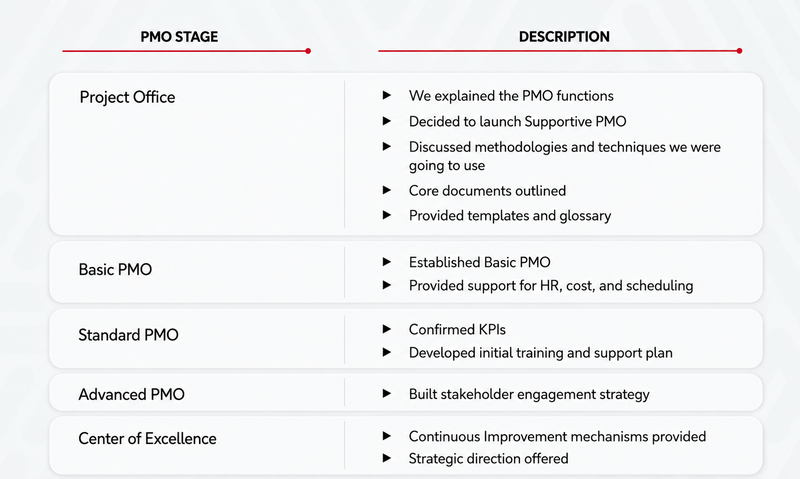
► Developing a phased implementation roadmap that enabled the organization to establish foundational PMO capabilities while preparing for long-term maturity and continuous improvement.
► Developing an OKR-aligned KPI framework covering participant reach, training completion, placement outcomes, partner onboarding, stakeholder satisfaction, project completion, and platform-launch performance.
Implementation
The PMO was established through a structured three-phase implementation completed within three months.
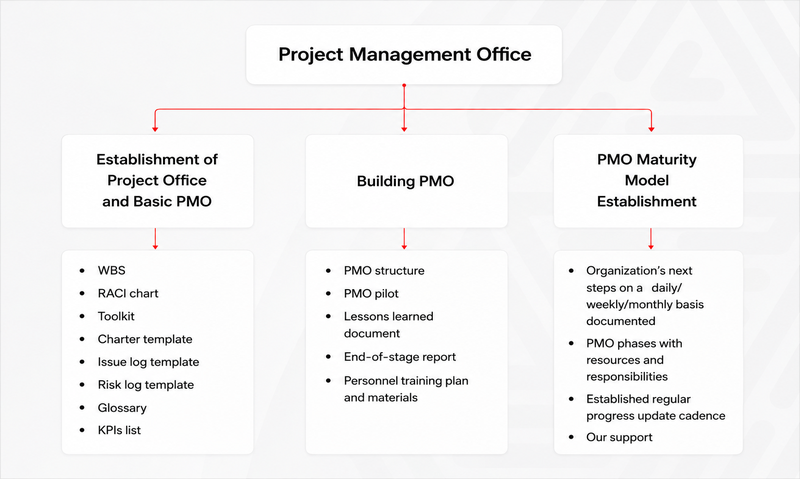
Stage 1 – Establishment of the Project Office and Basic PMO
The initial phase focused on building the organization's project management foundation by developing core governance documentation and standardized project management tools.
Key deliverables included:
► Work Breakdown Structure (WBS)
► RACI Chart
► PM Toolkit
► Project Charter template
► Issue Log template
► Risk Log template
► Project Management Glossary
► KPI framework
The framework connected project-level reporting with organizational OKRs. Measures included participant enrolment and training completion, six-month placement rates, partner onboarding, stakeholder satisfaction, project completion, model-delivery milestones, and digital-platform launch performance.
Together, these deliverables established a standardized project management framework that enabled consistent planning, execution, reporting, governance, and performance measurement across the organization, while linking individual projects to broader workforce-development targets.
Stage 2 – Building the PMO
The second phase focused on operationalizing the PMO through governance development and pilot implementation.
The pilot demonstrated how the PMO could provide consistent oversight across programs with different objectives, delivery partners, participant targets, timelines, and reporting requirements.
Key deliverables included:
► PMO organizational structure
► PMO pilot implementation
► Lessons Learned documentation
► End-of-stage reporting
This phase translated the governance model into operational practice, providing the organization with a repeatable framework for project oversight, decision-making, and continuous improvement.
Stage 3 – PMO Maturity Model Establishment
The final phase established a roadmap for long-term PMO development and continuous improvement.
Deliverables included:
► PMO maturity roadmap with daily, weekly, and monthly activities
► Defined implementation phases with roles and responsibilities
► Governance milestones and future meeting schedule
► Ongoing advisory framework for future PMO growth
The roadmap provided management with a structured framework for scaling PMO capabilities, strengthening governance, and supporting continuous organizational improvement as the organization expanded.
Results
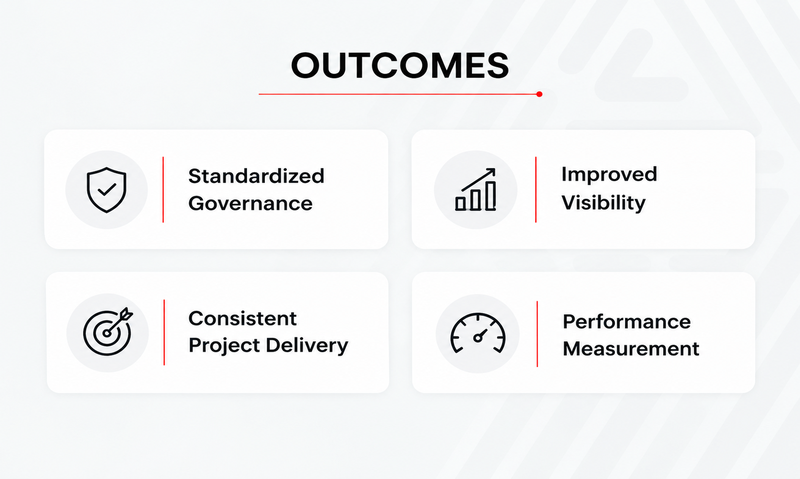
The organization successfully established a Project Management Office that introduced standardized governance, documentation, and project management practices across its operations. The engagement created a structured framework for managing projects more consistently while improving visibility, accountability, and organizational alignment.
Key outcomes included:
► Project governance established: A centralized Project Management Office introduced consistent governance, standardized project oversight, and a unified management approach across multiple programs.
► Standardized delivery framework implemented: Project documentation, governance processes, templates, and reporting standards were unified to improve consistency, transparency, and organizational oversight.
► Long-term PMO roadmap delivered: A phased maturity model provided leadership with a practical framework for expanding PMO capabilities, improving governance, and supporting future organizational growth.
► Performance management aligned with organizational OKRs: The KPI framework connected project reporting with strategic measures covering participant reach, training completion, placement outcomes, partner engagement, stakeholder satisfaction, project completion, and launch milestones.
► Large-scale program delivery supported: The PMO established the governance and reporting structure required to oversee workforce programs targeting 4,000 participants and a 75% placement rate for newly upskilled participants within six months.
► Strategic initiatives integrated into one delivery framework: The PMO created consistent oversight for partner onboarding, the Quebec delivery model, the Learning Sandbox platform, and the access-portal implementation.
The engagement established a scalable project management operating model that strengthened governance, standardized delivery, improved organizational visibility, and enabled the organization to manage ambitious participant, placement, partner, and platform objectives through one consistent PMO framework.